
Paper: Enhanced Follower Framework for Lifelong Multi-Agent Path Finding: A Hierarchical Turn Penalty Approach
Authors: Yihan Zhang, Zhaokai Liu, Ling Yao, Jurong Chen, Lin Wang, Guanglin Zhang
Venue: 45th Chinese Control Conference (CCC), 2026
Role: Co-author
The simulation-to-operation gap
Lifelong Multi-Agent Path Finding coordinates many robots that repeatedly receive new pickup or delivery goals. Grid-based benchmarks usually assign one step to a straight move, a turn, or a wait. A warehouse AGV does not experience those actions equally: turning requires deceleration, rotation, and acceleration, and unnecessary stops also consume operating time.
This creates a gap between optimizing paths in simulation and improving throughput on a physical system.
The project asks:
Can a planning-and-learning LMAPF system reduce physically expensive turns without sacrificing collision avoidance or task throughput?
A kinematics-aware evaluation
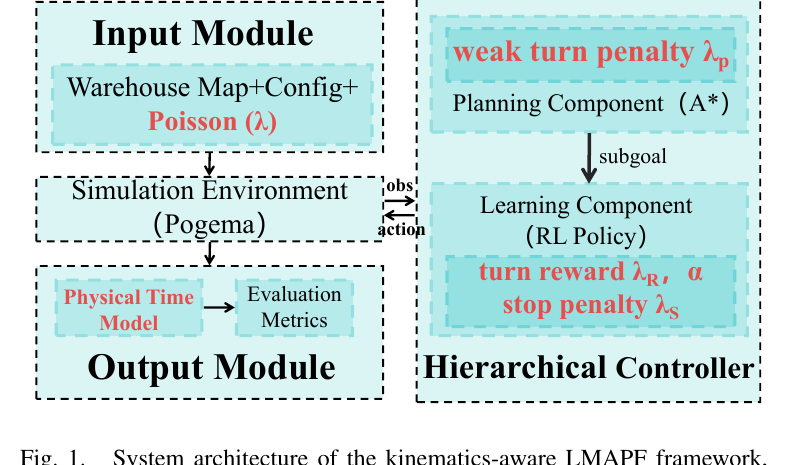
The work introduces a lightweight AGV time-cost model rather than a full dynamics simulator. It adds the first-order cost of straight traversal, 90-degree turns, and stop actions while preserving the discrete decision interface used by the original Follower framework.
Performance is evaluated with four complementary measurements:
- Throughput: tasks completed per evaluation step;
- Turns per Task (TPT): how tortuous the executed paths are;
- Operational Time per Task (OTT): motion and waiting time normalized by completed tasks;
- Stop Ratio: a diagnostic for whether a method reduces turns by waiting excessively.
Hierarchical turn penalties
The framework introduces kinematic awareness at two connected levels.
- The global A* planner receives a weak directional-change cost. This creates a waypoint prior that prefers less tortuous routes without overwhelming distance and obstacle considerations.
- The local reinforcement-learning policy receives different rewards for efficient and inefficient turns, together with a stop penalty. This shapes reactive collision avoidance and waypoint following, where many unnecessary turns are actually produced.
A Poisson-distributed task generator is also used to emulate variable order-batch sizes in lifelong warehouse operation.
Experimental results
Experiments cover three warehouse layouts, multiple fleet sizes, and five random seeds. Averaged over nine map-scale configurations, the full method:
- increases throughput by 7.0%;
- reduces Turns per Task by 24.4%;
- reduces Operational Time per Task by 20.3%.
Ablations show that the local turn-aware reward contributes most of the improvement, while the planning-level cost provides a complementary global bias. The simultaneous throughput increase and OTT reduction also indicate that the gains are not explained simply by making robots wait more often.
How I present this work
This is a collaborative, co-authored publication rather than one of my lead-author projects. I include it because it connects multi-agent coordination with an issue that matters in deployment: a path that looks efficient in grid steps may still be operationally expensive for a real robot.
Connection to my broader research
This project complements the Coordinate side of my research. It shows that the representation used for decision-making - here, unit grid steps - can hide costs that appear only during execution. Better coordination requires objectives and metrics that retain the information relevant to the physical system.