Lifelong Multi-Agent Path Finding
Enhanced Follower Framework for Lifelong Multi-Agent Path Finding: A Hierarchical Turn Penalty Approach
1 School of Automation and Intelligent Sensing, Shanghai Jiao Tong University
2 Technology R&D Department, Guangzhou Saite Intelligent Technology Co., Ltd.
3 Department of Communication Engineering, College of Information Science and Technology, Donghua University
45th Chinese Control Conference · CCC 2026
Problem formulation
AGV-Inspired Time-Kinematic Model
The objective of LMAPF is to dynamically assign conflict-free paths to a fleet of automated guided vehicles (AGVs) as they continuously receive new goals.
Conventional LMAPF evaluations mainly count discrete steps and therefore treat straight moves, turns, and waiting as comparable unit actions. This abstraction misses a key physical effect in warehouse AGVs: changing direction requires deceleration, rotation, and re-acceleration. We therefore introduce a lightweight time-kinematic model as an evaluation-level surrogate.
We assume synchronized grid execution. At each simulator step, an AGV either moves to a four-neighboring cell or executes a stop action. A straight one-cell move consumes a base traversal time, a direction change adds a turn-induced delay, and a stop action occupies one control step.
| Symbol | dcell | vmax | a | trot | tbase | tturn | tstop |
|---|---|---|---|---|---|---|---|
| Value | 1.0 m | 2.0 m/s | 0.6 m/s² | 1.5 s | 0.50 s | 4.83 s | 0.50 s |
Evaluation Metrics
- Throughput
- Throughput measures the number of completed tasks per evaluation step.
- Turns per Task (TPT)
- Turns per Task (TPT) measures the average number of executed turns per completed task.
- Operational Time per Task (OTT)
- Operational Time per Task (OTT) measures the average cumulative robot-time required for each completed task after accounting for both physical motion and waiting.
- Stop Ratio
- Stop Ratio is the number of stop actions divided by the total number of executed actions.
Method
Hierarchical Turn Penalty Mechanism
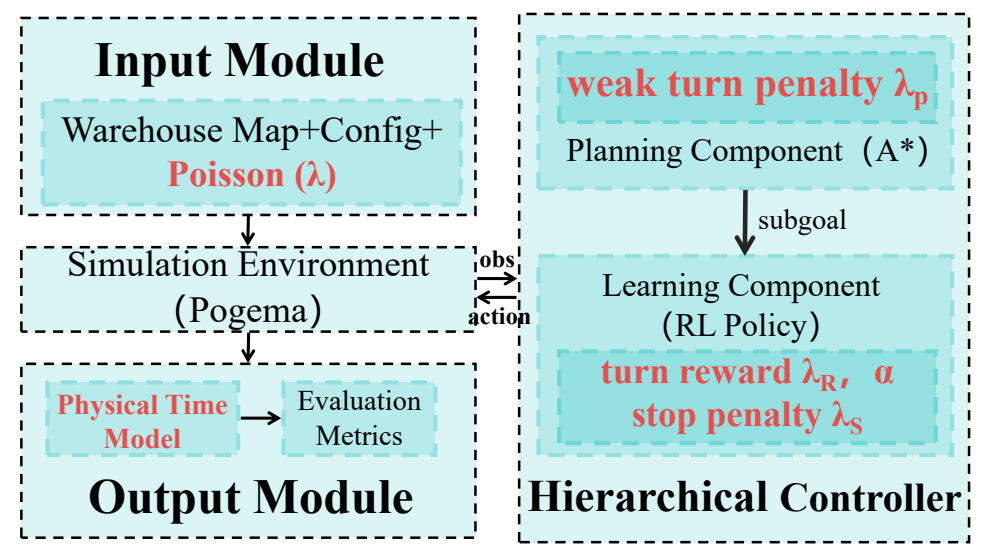
Our framework is built upon the Follower architecture, a decentralized hybrid pipeline that synergizes global planning with local reactive control.
The Global Planner employs an A* algorithm to generate individual paths which are decomposed into sequences of waypoints for localized navigation. Within this hierarchy, multi-agent conflicts are resolved at the local level through reactive RL actions such as yielding or detouring.
-
Turn Penalty in the Planning Component
The original implementation penalizes nodes that are heavily occupied by other agents to avoid congestion. We extend this heuristic by modifying the edge cost function during the node expansion phase to mildly penalize tortuous routes.
The planner slightly biases the waypoint prior toward smoother paths without dominating the original congestion-aware cost.
-
Turn Penalty in the Learning Component
Unlike a blanket turn penalty, our local reward distinguishes efficient turns from inefficient turns. A turn that moves the agent closer to its current waypoint is treated as an efficient turn; otherwise, it is treated as an inefficient turn. A waiting-aware stop penalty increases with consecutive stop actions, up to a fixed cap.
The planning-level penalty shapes a smoother waypoint prior, while the RL-level reward decides whether to follow, wait, or detour under local conflicts. This loose coupling preserves local flexibility while still making the executed trajectory sensitive to the physical cost of turns.
Poisson-Distributed Task Sequence Generation
To emulate variable order-batch sizes in warehouse operations, we use a Poisson-distributed task sequence generator. This generator controls the number of targets assigned to each agent during an episode.
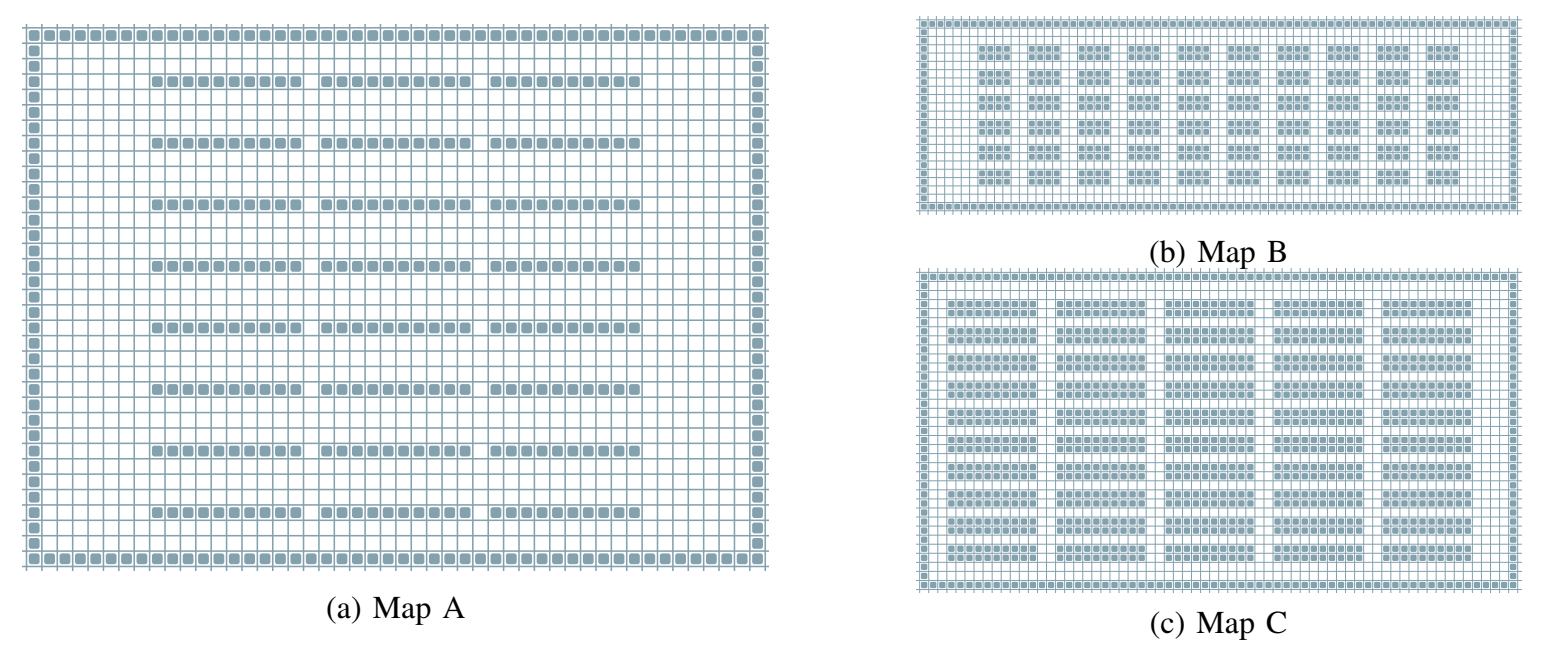
Targets are sampled from traversable cells adjacent to storage racks, which represent pick/replenishment access points. This creates localized task hotspots and variable task-list lengths while preserving a simple reproducible task-generation process.
Experiments
Experimental Setup
Experiments are conducted using POGEMA, a benchmark platform for cooperative multi-agent reinforcement learning (MARL) and MAPF.
We vary the fleet size N ∈ {32, 64, 128} over the three warehouse layouts in Fig. 3. Task sequences use Ki = max(1, Xi) with Xi ∼ Poisson(3). Each model is evaluated over five random seeds that vary task sampling and initial configurations.
Training Details and Throughput Stability
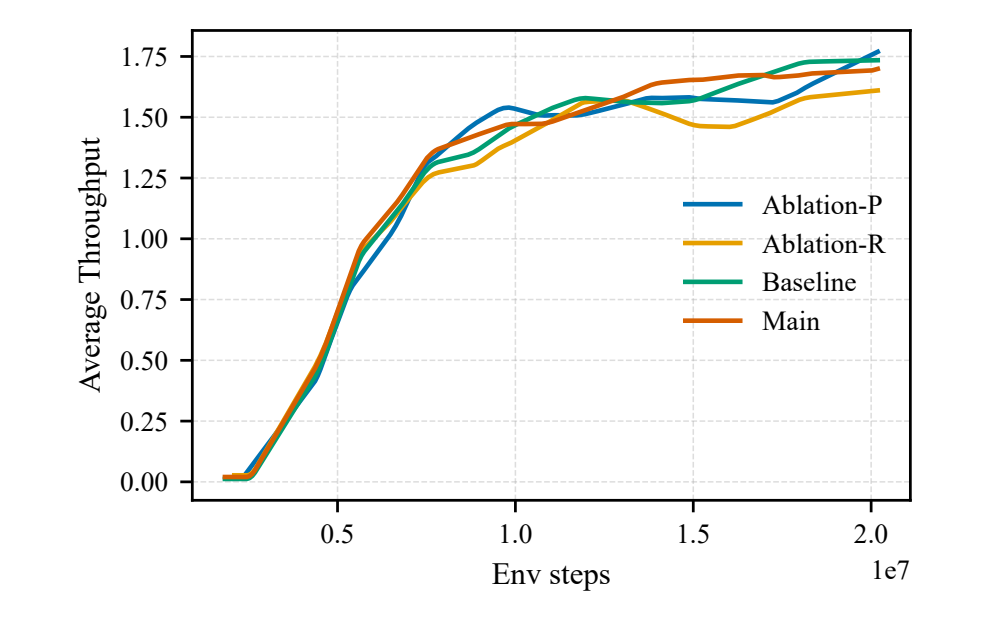
We kept the same neural network architecture and the same Proximal Policy Optimization (PPO)-style hyperparameters (via Sample Factory) across all four models to ensure a fair comparison.
- Baseline: the original Follower-style configuration without planning or learning-level turn awareness (λP = 0, λR = 0, λS = 0).
- Ablation-P: planning-only weak turn awareness, using λP = 0.01 and disabling the learning-level turn and stop terms (λR = 0, λS = 0).
- Ablation-R: learning-only turn awareness, using λP = 0, λR = 0.02, α = 0.25, λS = 0.003, β = 0.002, and λSmax = 0.02.
- Main: the full hierarchical design, combining Ablation-P and Ablation-R with λP = 0.01, λR = 0.02, α = 0.25, λS = 0.003, β = 0.002, and λSmax = 0.02.
Experimental results
Main Performance Comparison
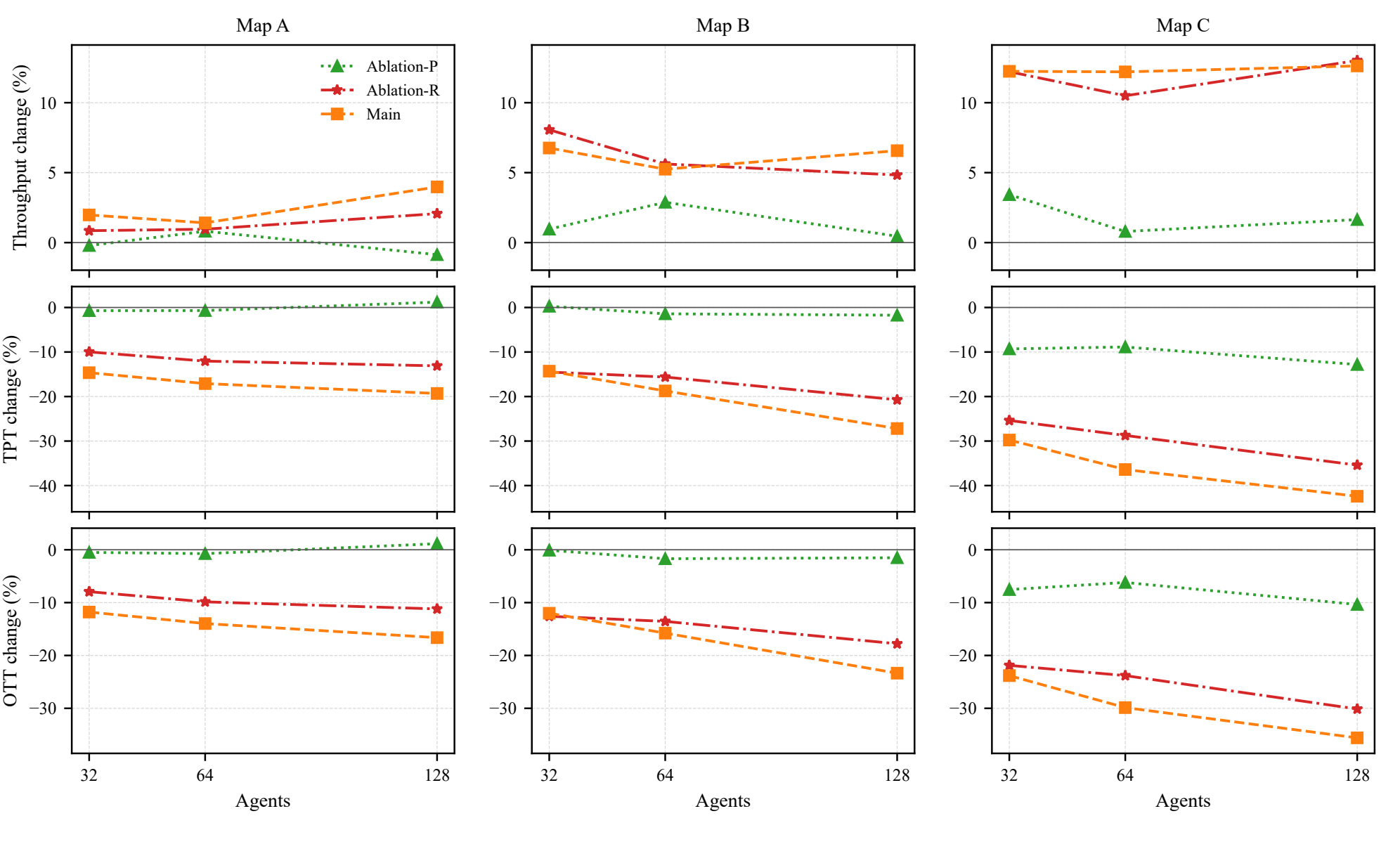
Averaged over the nine map-scale configurations, Main increases throughput by 7.0%, reduces TPT by 24.4%, and reduces OTT by 20.3%.
| Map | N | Baseline | Ablation-P | Ablation-R | Main | ||||||||
|---|---|---|---|---|---|---|---|---|---|---|---|---|---|
| Thr | TPT | OTT | Thr | TPT | OTT | Thr | TPT | OTT | Thr | TPT | OTT | ||
| Map A | 32 | 4.25 | 2.84 | 17.62 | 4.24 | 2.82 | 17.53 | 4.29 | 2.56 | 16.22 | 4.33 | 2.43 | 15.54 |
| Map A | 64 | 9.55 | 2.95 | 17.71 | 9.63 | 2.93 | 17.58 | 9.64 | 2.60 | 15.97 | 9.69 | 2.45 | 15.24 |
| Map A | 128 | 22.37 | 2.84 | 16.62 | 22.18 | 2.88 | 16.81 | 22.83 | 2.47 | 14.76 | 23.26 | 2.29 | 13.85 |
| Map B | 32 | 4.41 | 2.52 | 16.02 | 4.46 | 2.52 | 16.00 | 4.77 | 2.15 | 14.00 | 4.71 | 2.16 | 14.10 |
| Map B | 64 | 9.15 | 2.81 | 17.27 | 9.42 | 2.77 | 16.98 | 9.67 | 2.37 | 14.93 | 9.63 | 2.29 | 14.55 |
| Map B | 128 | 19.03 | 3.11 | 18.42 | 19.12 | 3.06 | 18.14 | 19.95 | 2.47 | 15.14 | 20.28 | 2.27 | 14.12 |
| Map C | 32 | 3.47 | 2.92 | 19.61 | 3.59 | 2.65 | 18.13 | 3.90 | 2.18 | 15.32 | 3.90 | 2.05 | 14.94 |
| Map C | 64 | 5.67 | 3.71 | 24.31 | 5.72 | 3.38 | 22.80 | 6.27 | 2.65 | 18.52 | 6.36 | 2.36 | 17.05 |
| Map C | 128 | 11.42 | 4.23 | 26.13 | 11.61 | 3.69 | 23.42 | 12.90 | 2.74 | 18.25 | 12.86 | 2.44 | 16.83 |
Result Analysis
The ablation results show that Ablation-P alone produces only small changes, whereas Ablation-R yields much larger TPT and OTT reductions. This indicates that many inefficient turns arise from local reactive decisions during waypoint following and collision avoidance.
Main consistently outperforms the Baseline, while Ablation-R occasionally achieves comparable or slightly higher throughput. Overall, Main provides the strongest balance between throughput, TPT reduction, and OTT reduction, showing that the global waypoint prior and local reward shaping are complementary.
| Configuration | Baseline | Ablation-P | Ablation-R | Main |
|---|---|---|---|---|
| Stop Ratio | 8.08% | 9.35% | 10.53% | 12.82% |
Conclusion
Conclusion and Future Work
We further proposed a Hierarchical Turn Penalty Mechanism: the planning layer injects a weak directional cost into A*, while the learning layer uses an efficient/inefficient turn-aware reward and a waiting-aware stop penalty. Experiments show that Main improves throughput over the Baseline and consistently reduces both TPT and OTT.
We also plan to calibrate the lightweight time-cost model with higher-fidelity robot simulations and physical AGV logs, especially for stop-and-go behavior, acceleration profiles, and continuous turning dynamics. Finally, extending this framework from discrete grid representations to continuous state and action spaces will further enhance its applicability to non-holonomic robotic systems in physical fulfillment centers.