Workpiece 1 · 9 views
0.093 0.064 mm
31.2% lower loop-closure RMSE
Multi-view point cloud registration · Fringe projection profilometry
1 School of Automation and Intelligent Sensing, Shanghai Jiao Tong University
2 Shanghai Institute of Aerospace Technical Foundation
3 State Key Laboratory of Submarine Geoscience, Shanghai Jiao Tong University
* Corresponding author: Zhuojiang Nan
Optics and Lasers in Engineering · Under review
The problem
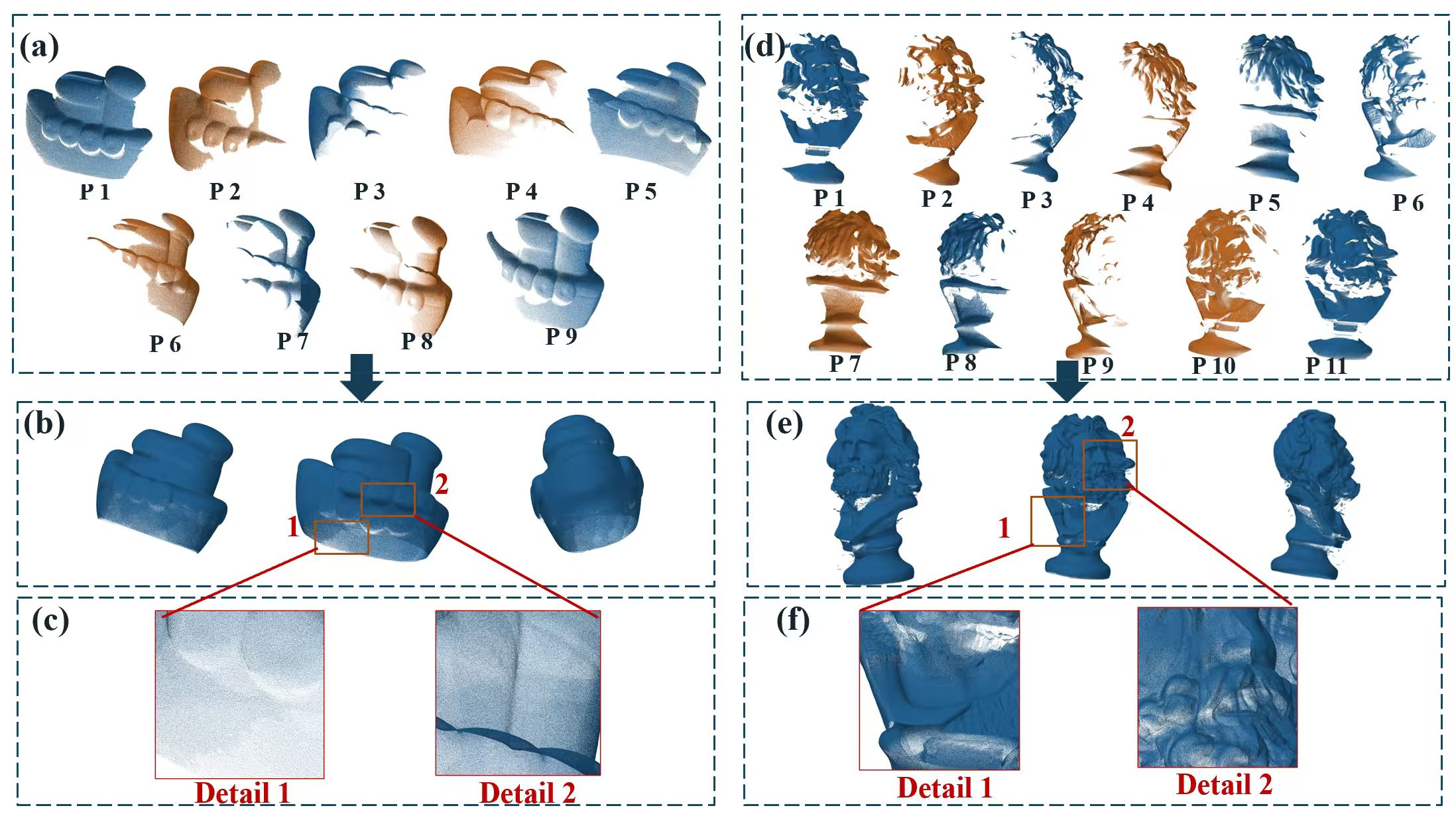
In sequential multi-view registration, rotation and translation errors can accumulate and cause loop-closure errors. Joint pose refinement is therefore needed after pairwise alignment. Both accurate alignment of overlapping local surfaces and consistent relative poses among the views are required.
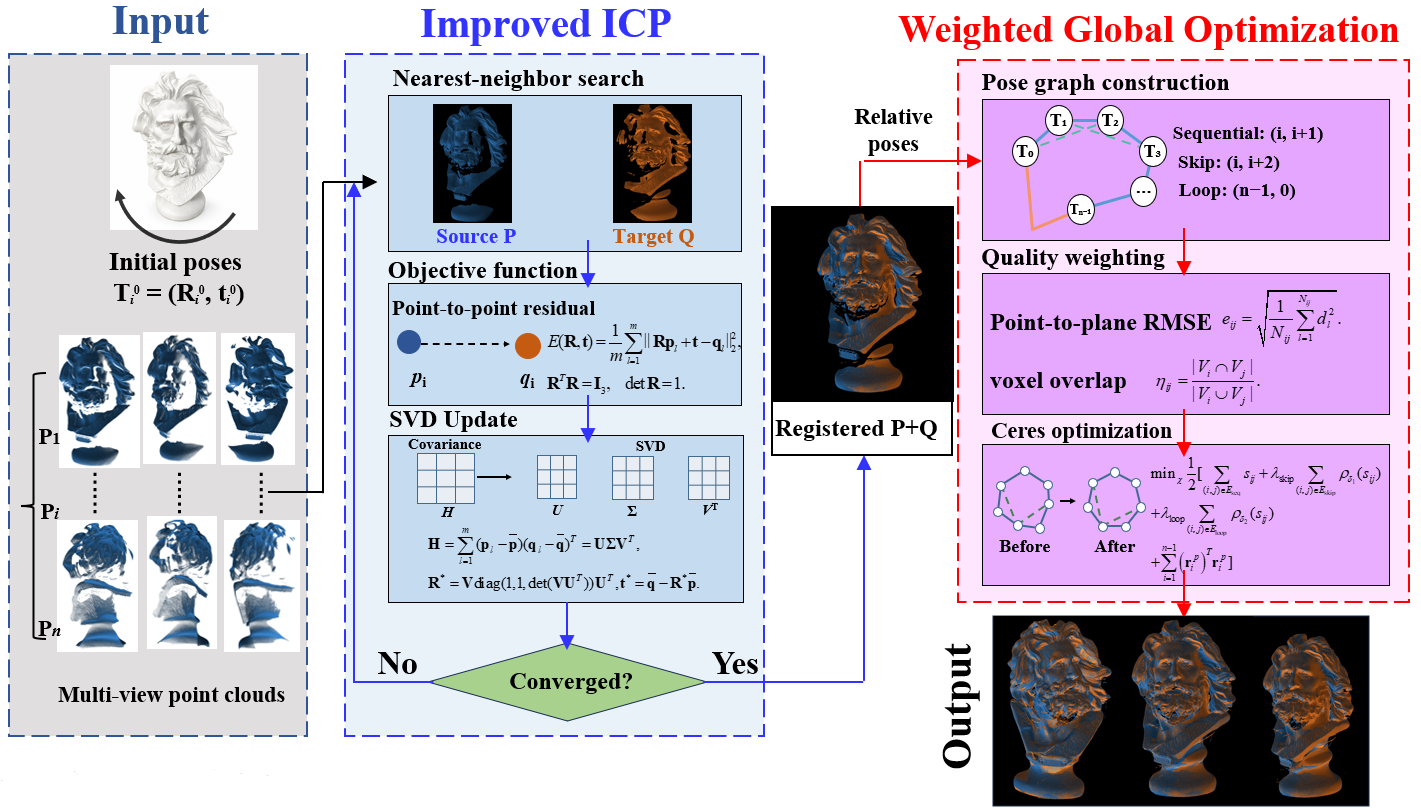
We propose a multi-view registration method that combines improved ICP with a quality-weighted pose graph. Mutual nearest-neighbor verification, iterative search-radius reduction, and GPU-parallel search are used to estimate relative poses between overlapping views. The pose graph combines sequential, skip, and loop-closure measurements with soft turntable priors. Geometric constraints are weighted using voxel overlap and point-to-plane RMSE, and the view poses are jointly optimized with Huber losses applied to the skip and loop-closure terms. The method is evaluated using two objects with different surface geometries.
Method
The initial estimate for pairwise fine registration is obtained by turntable-based coarse registration. The improved iterative closest point (ICP) algorithm combines mutual nearest-neighbor verification with iterative reduction of the search radius to filter correspondences. The nearest-neighbor searches are performed in parallel on a graphics processing unit (GPU). Each iteration combines parallel nearest-neighbor searches, mutual nearest-neighbor verification, and SVD-based rigid transformation estimation.
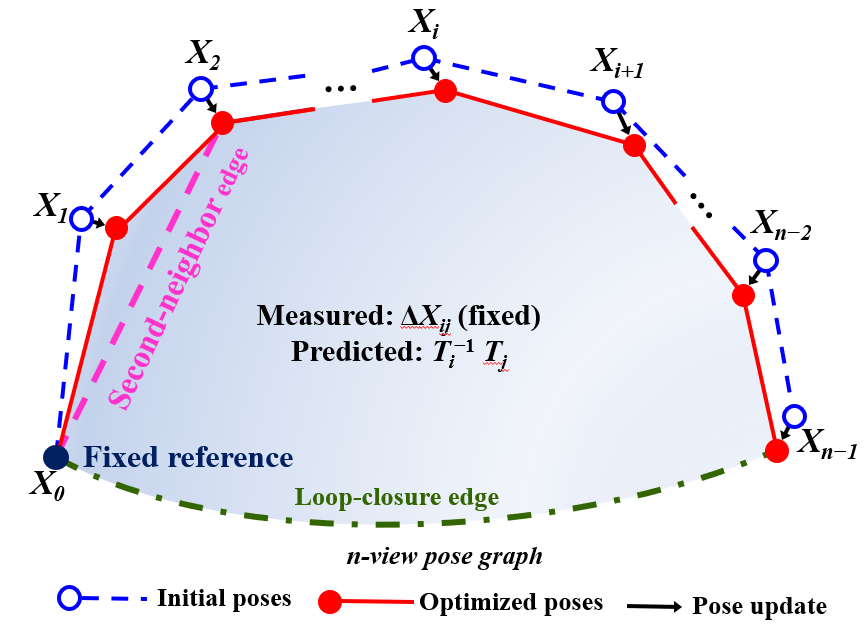
The nodes correspond to the view poses, and the factors are sequential, skip-edge, and loop-closure constraints, together with soft turntable priors. The geometric registration constraints are weighted based on the voxel-based overlap ratio and a Cauchy weighting function of the point-to-plane RMSE. Separate information matrices are assigned to the turntable priors.
The optimization problem is solved using Ceres Solver. We fix the initial node at T0 = I4. The six pose parameters of all remaining nodes are optimized jointly. The relative pose measurements remain fixed during optimization. We apply Huber robust kernels to skip edges and loop-closure edges. Finally, we obtain global alignment by transforming each view’s original point cloud into the initial reference frame using the optimized transformations Ti. These rigid transformations preserve the geometry within each view.
Experimental setup
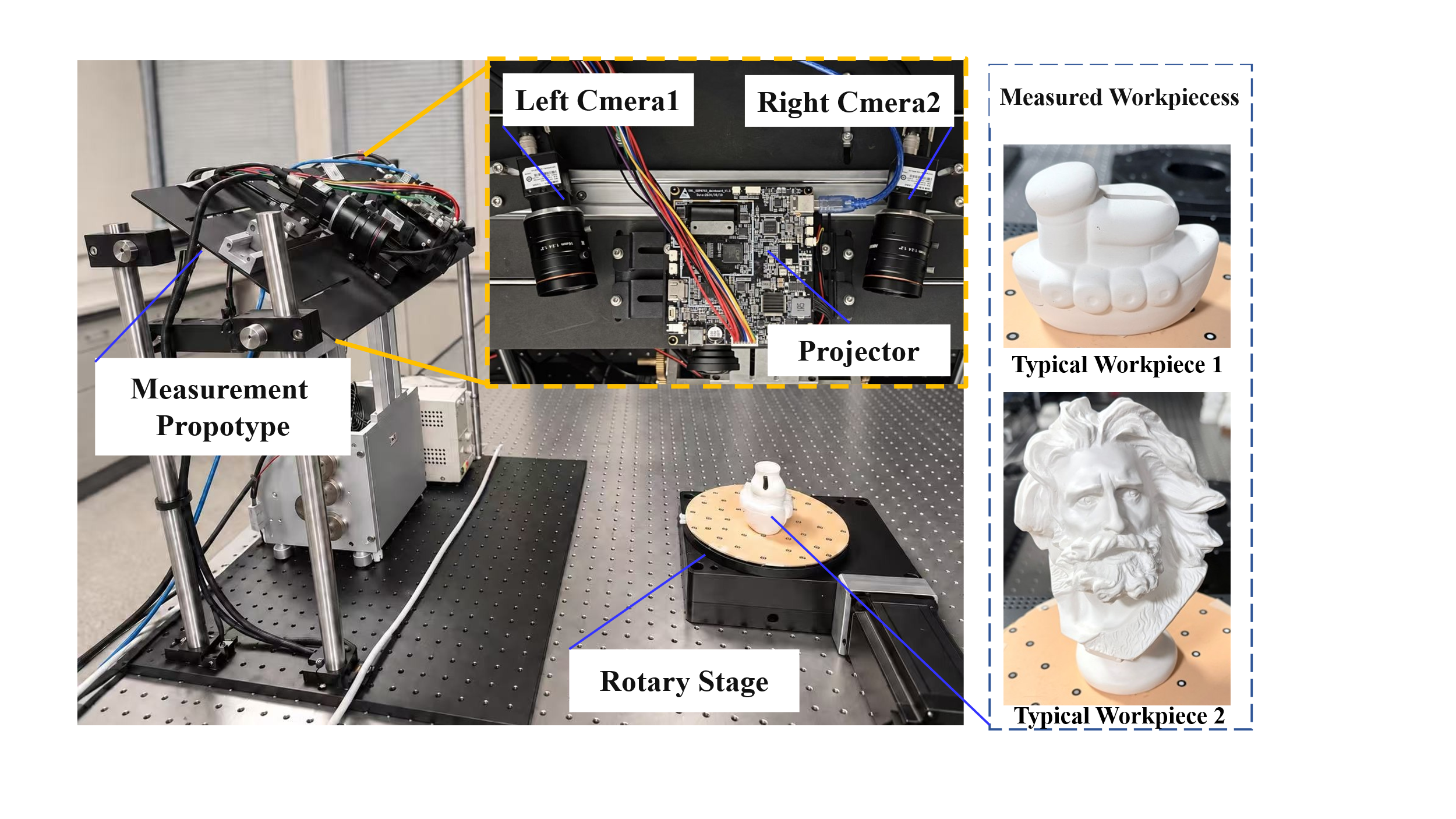
A binocular structured-light system using fringe projection acquired workpiece surface point clouds (Fig. 5). The cameras and projector remained fixed while the workpiece rotated stepwise. At each prescribed angle, the turntable was held stationary while the projector sequentially projected encoded fringe patterns onto the surface. Both cameras captured the corresponding fringe images. Phase retrieval, stereo matching, and triangulation were then used to reconstruct the surface point cloud for each view.
Workpiece 1 had a relatively regular surface with limited occlusion. Workpiece 2 featured pits, recesses, and locally occluded regions. The two datasets contain 9 and 11 views, respectively, acquired over a full 360° rotation. Angular increments were adjusted to maintain approximately 50% overlap between consecutive point clouds. Shared surface regions were also retained for registration between views i and i+2 and for loop closure between the first and last views.
Experimental results
To assess the effect of global optimization on error accumulated during sequential registration, we compared loop-closure RMSE at three stages. These were coarse registration, sequential fine registration using improved ICP, and global optimization. For each stage, we calculated the point-to-plane RMSE over the overlapping region of the first and last point clouds using the corresponding stage-specific poses. This metric characterizes the geometric discrepancy between the first and last views. The reduction in loop-closure RMSE after global optimization was calculated using sequential fine registration with improved ICP as the baseline.
Workpiece 1 · 9 views
0.093 0.064 mm
31.2% lower loop-closure RMSE
Workpiece 2 · 11 views
0.178 0.063 mm
64.6% lower loop-closure RMSE
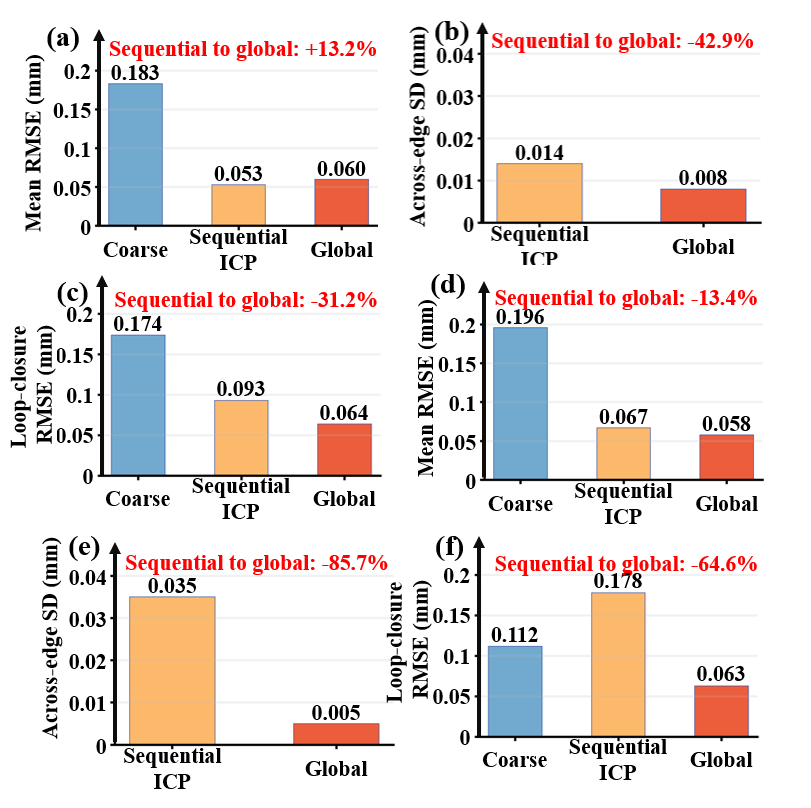
For Workpiece 1, although pose graph optimization reduced the standard deviation from 0.014 to 0.008 mm (42.9%), the mean RMSE increased from 0.053 to 0.060 mm. The increase was 0.007 mm. Not all error metrics improved. For Workpiece 2, pose graph optimization reduced the mean RMSE from 0.067 to 0.058 mm (13.4%) and the standard deviation from 0.035 to 0.005 mm (85.7%).
| Workpiece | Method | Mean RMSE | Across-edge SD | Loop-closure RMSE |
|---|---|---|---|---|
| Workpiece 1 | FGR–ICP | 0.071 | 0.033 | 0.159 |
| Workpiece 1 | ISS–ICP | 0.095 | 0.044 | 0.189 |
| Workpiece 1 | Proposed | 0.060 | 0.008 | 0.064 |
| Workpiece 2 | FGR–ICP | 0.086 | 0.042 | 0.200 |
| Workpiece 2 | ISS–ICP | 0.072 | 0.039 | 0.172 |
| Workpiece 2 | Proposed | 0.058 | 0.005 | 0.063 |
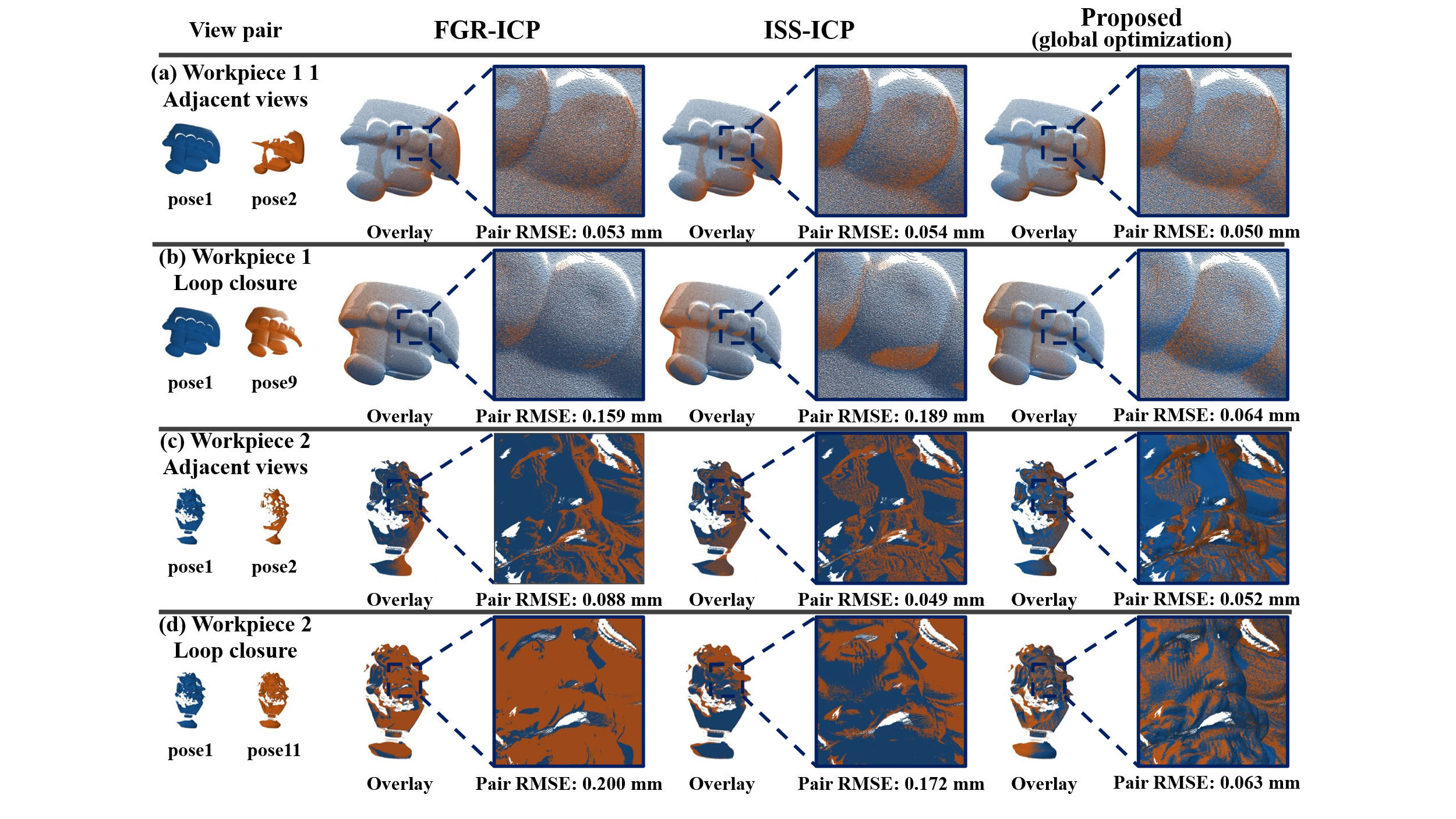
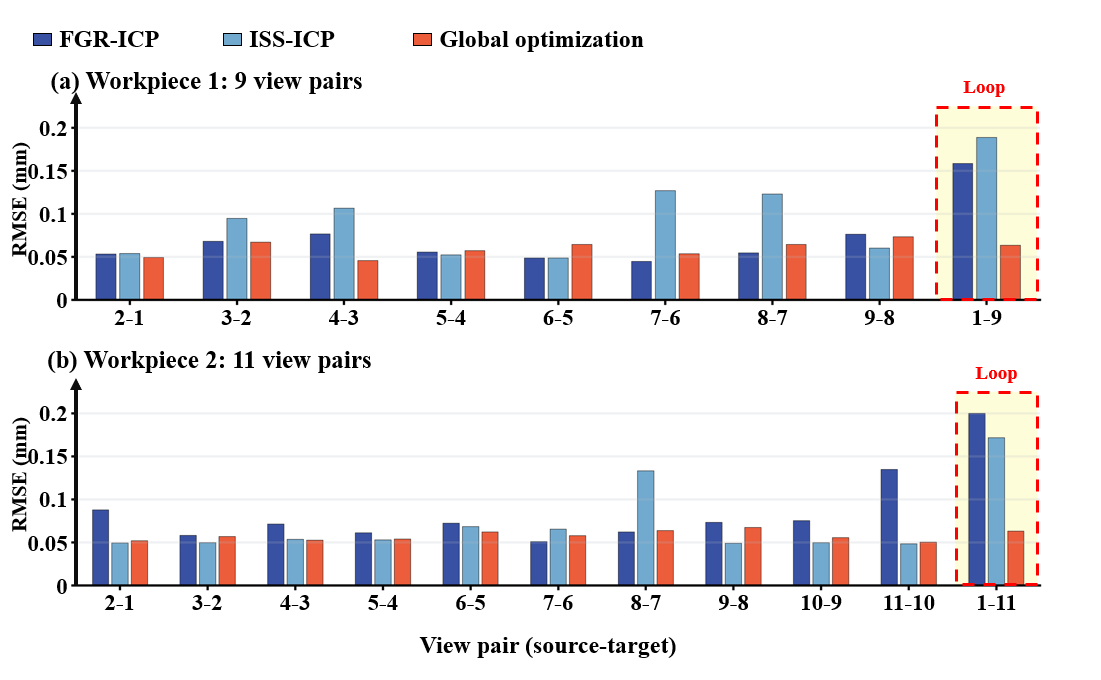
All statistics are computed over consecutive-view pairs and the first-to-last loop-closure pair (9 pairs for Workpiece 1 and 11 for Workpiece 2). Skip-edge constraints and turntable priors are excluded from these statistics. The population standard deviation characterizes variation in pairwise RMSE, not measurement repeatability.
Scope and next steps
The reconstructed regions are limited to surfaces observed during acquisition. To assess registration quality, we use loop-closure RMSE and per-edge error statistics to quantify first-to-last misalignment and cross-view geometric consistency, respectively. These registration residuals are not an independent measurement of absolute surface accuracy.
Future work will evaluate more workpieces and acquisition conditions, particularly lower overlap, varied viewpoints, larger initial pose errors, increased occlusion, and errors in turntable priors.